
Resurfacing vs Refacing vs Repainting: Cabinet Terms Explained
Last modified: November 7, 2026
Quick answer
Repainting is a new coat of colour, usually brushed or rolled. Refinishing is a full process of cleaning, sanding, priming and spraying a durable, cured coating on your existing cabinets. Refacing replaces the doors and drawer fronts and finishes the frames to match. Resurfacing is a loose term that can mean either refinishing or refacing, so ask what is included.
Ask three contractors about updating your cabinets and you may hear three different words for what sounds like the same job. Resurfacing, refacing, refinishing, repainting: they get used loosely, and sometimes interchangeably, even though they describe very different amounts of work. Here is resurfacing vs refacing vs repainting, in plain English.
That matters, because the word on a quote decides what you keep, what gets replaced and how long your kitchen is out of action. Here is a plain-English glossary so you can compare options with confidence.
There is no official rulebook for these words. Each company describes its own process its own way. One business calls a sprayed finish “resurfacing,” another uses the same word for sticking laminate over old doors.
The simplest way to cut through it is to ask two questions about any option you are offered:
- Which parts stay: the boxes, the frames, the doors, the drawer fronts?
- Which parts are new, and which are only getting a new finish?
Repainting: a new coat of colour
Repainting usually means brushing or rolling paint onto your existing cabinets, often with the doors left on or painted in a garage. The cabinets are cleaned, sanded and primed, then painted in place.
It is the term most often linked with do-it-yourself projects, and it can work well when the prep is thorough. The trade-off is durability. Kitchen cabinets get handled, splashed and bumped every day, and a brushed household paint is a different product from a sprayed, cured cabinet coating. Brush marks, slow drying times and dust settling into wet paint are common frustrations.
If you like the idea of doing part of the work yourself but want a tougher finish on the pieces that get touched most, our DIY Kitchen Update Kit splits the job: we refinish your doors and drawer fronts in our shop, and you paint the frames with the materials and guidance in the kit.
Refinishing: same cabinets, factory-grade finish
Refinishing keeps your existing doors, drawer fronts and cabinet boxes and changes their colour and finish. It is the closest professional cousin to repainting, but the process is different.
When we refinish a kitchen, the doors and drawer fronts are removed and taken to our shop in Aldergrove. There they are sprayed with an industrial two-component coating and bake-cured, a factory-grade process that is hard to match in a home. The cabinet frames are finished on site.
What that looks like for you:
- About four days of work in your home
- A 7 to 10 day gap while your doors are in the shop
- Less dust and noise in the house, since the doors are done off site
- A written 3-year refinishing warranty
Refinishing makes sense when your cabinets are solid and you like the door style, but the colour or finish feels tired. You can see the full process on our cabinet refinishing page.
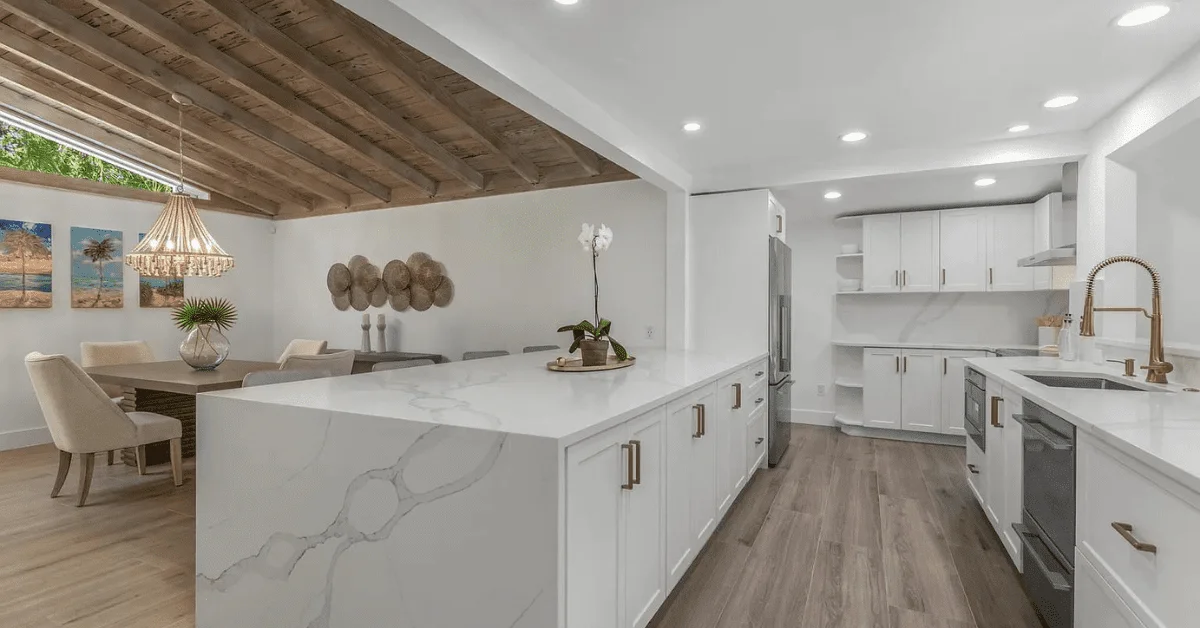
Refacing: new doors on the cabinets you have
Refacing keeps your existing cabinet boxes but replaces the doors and drawer fronts with brand-new ones. The frames are then finished to match, so the old and new parts look like one set.
This is the option to look at when the doors themselves are the problem. Swelling near the sink or dishwasher, chipped or damaged edges, or a door style that simply is not you any more are all good reasons to reface rather than refinish. Your layout stays the same, and you avoid tearing out boxes that are still sound.
Our refacing comes with a written 5-year warranty on the new doors. The cabinet refacing page walks through door styles and what the work involves.
Resurfacing vs refacing: the term that means different things
Resurfacing is the vaguest word in the group. Depending on who is using it, it can mean:
- Refinishing, with a new sprayed or painted finish on the existing doors and frames
- Covering existing surfaces with a laminate or veneer layer
- A general catch-all for any cabinet update short of full replacement
Because it covers so much ground, treat “resurfacing” on a quote as a prompt to ask more questions. Find out whether the doors are being kept or replaced, whether anything is being applied over the old surface, what product is used and how it is cured. Those answers tell you far more than the label does.
Other terms you may come across
Cabinet replacement
Replacement means removing the existing boxes and installing new ones. It is the right call when the boxes are damaged or you want a different layout, but it is a much bigger job that often affects countertops, backsplashes and flooring.
Organizers and modifications
Pull-outs, garbage and recycling drawers, blind-corner solutions, converting doors to drawers, adding an island or running cabinets to the ceiling: these change how the kitchen works rather than how it looks. They can be added on their own or alongside a refinish or reface.
Two-component coating
A coating made from two parts that are mixed just before spraying and react as they cure. This kind of product is common in industrial and factory finishing because it cures harder than a typical one-part paint.
Which word fits your kitchen?
Once the terms are clear, the choice usually comes down to the condition of your cabinets and how much change you want:
- Boxes and doors are solid, you want a new colour: refinishing
- Boxes are solid, doors are damaged or dated in style: refacing
- You want to save by doing part of the work yourself: a DIY kit
- Boxes are failing or the layout no longer works: replacement or modifications
Cost depends on the size of your kitchen and the option you choose, so there is no one-size-fits-all price. Our kitchen cost calculator gives you a starting point before anyone visits.
Get a clear answer for your kitchen
Since 2009, our family-owned team has updated about 7,000 kitchens across the Lower Mainland, with 30+ in-house employees and no subcontractors. We are happy to explain exactly what we would do and why.
If you are still unsure which option fits, book a free in-home quote. An estimator will look at your cabinets, talk through what you want and give you clear, line-item pricing.
Frequently asked questions
Is cabinet resurfacing the same as refinishing?
Sometimes. Some companies use resurfacing to mean refinishing, while others mean applying laminate or veneer over existing surfaces. Ask whether your doors are kept or replaced and what product goes on them before comparing quotes.
What is the difference between refinishing and refacing?
Refinishing keeps your existing doors, drawer fronts and boxes and gives them a new colour and finish. Refacing keeps the boxes but replaces the doors and drawer fronts with new ones, then finishes the frames to match.
Can I repaint my kitchen cabinets myself?
Yes, with careful cleaning, sanding and priming, though a brushed finish is usually less durable than a sprayed, cured coating. A middle path is a kit where the doors and drawer fronts are refinished professionally and you paint the frames.


